 Log in



Ube has moved far beyond the novelty-dessert stage. The purple yam’s mellow, earthy sweetness now appears in bakery cases, boba shops, ice cream menus, packaged snacks and café drinks—but successful ube products depend on more than making food purple. The best versions balance ube’s soft vanilla-like, nutty and coconut-adjacent character with the right base, sweetness and texture.
This complete ube guide explains what ube tastes like, how ube differs from taro and sweet potato, and how to choose between Purple Ube Extract, Clear Ube Extract and Natural Ube Extract (No Coloring). You will also find practical recipes for ube lattes, milk tea, syrup, cake, brownies, cookies, cheesecake, ice cream, soft serve and more—plus a step-by-step system for turning a home recipe into a repeatable commercial product.
If you are developing for a café, bakery, dessert shop or food brand, treat this as your ube product-development playbook. Start with a small measured test, follow the documentation for the exact Dolce Flav product you choose, and validate the finished recipe after its real baking, freezing, holding or serving process.
What is ube?
Ube is a purple yam associated especially with Filipino cooking and desserts. Its botanical identity, culinary history and cultural meaning are distinct from purple sweet potatoes and taro. Fresh or frozen ube contributes flavor, color, starch, water and texture; ube halaya, a cooked purple yam jam, adds still more sugar, dairy or fat depending on the recipe. Ube extract is different: it is a concentrated flavoring used in small amounts to build a consistent ube profile without adding the same bulk or variability as yam or jam.
That distinction matters in recipe development. A scoop of ube halaya may thicken a filling, increase solids and deepen color. An extract primarily changes aroma and taste. It gives the formulator more independent control over flavor, texture, sweetness and color. Many excellent recipes use both: real ube or halaya for body and authenticity, plus extract to reinforce the aroma that can fade during baking or freezing.
What does ube taste like?
Ube is often described as gently sweet, earthy, creamy and nutty, with suggestions of vanilla and coconut. Those comparisons help a newcomer imagine it, but ube is not simply vanilla plus coconut. Its appeal is the quiet combination: a rounded root-vegetable depth beneath a dessert-friendly aroma. It tends to feel richer in dairy, coconut milk, butter and custard systems and brighter when balanced with a small amount of salt.
Because ube is relatively soft-spoken, aggressive ingredients can bury it. Dark roast coffee, heavy cocoa, excess cinnamon or sharp citrus may dominate. That does not make those pairings impossible; it means the supporting ingredients and dose must be intentional. White chocolate, cream cheese, coconut, vanilla, milk, brown butter and mild coffee are usually easier starting partners.
Ube vs. taro vs. purple sweet potato
These ingredients are often confused because they can appear in purple desserts and drinks, but they are not interchangeable. Ube is a purple yam. Taro is a different root with a starchier, nuttier and sometimes cereal-like profile. Purple sweet potatoes are also botanically and sensorially distinct, often tasting more directly sweet-potato-like.
| Ingredient | Typical flavor impression | Common uses | Development note |
|---|---|---|---|
| Ube | Mellow, earthy, vanilla-like and gently nutty | Halaya, cakes, ice cream, lattes and pastries | Color varies; flavor can need reinforcement after heat or freezing |
| Taro | Starchy, nutty, lightly cereal-like | Milk tea, steamed dishes, fillings and desserts | Purple café drinks labeled taro may use color and flavor systems beyond the root |
| Purple sweet potato | Sweet, earthy and recognizably sweet-potato-like | Pies, breads, mash, fillings and natural color | Can bring strong starch and dense texture |
For clear labeling and a trustworthy menu story, name the flavor you are actually building. Do not call a taro product ube because both can be purple. If a recipe combines real ube, another purple vegetable and concentrated flavor, review how the product is represented and labeled in the market where it will be sold.
Choosing the right Dolce Flav ube extract
The best ube flavoring is the one that matches the desired flavor story, color system and finished application. Dolce Flav offers more than one ube direction, allowing developers to separate flavor from appearance or choose a ready-made purple expression.
Purple Ube Extract
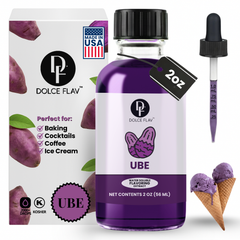
Purple Ube Extract is the direct choice when you want recognizable ube flavor and a purple visual cue in a compatible water-based application. It suits projects such as lattes, milk tea, cakes, frostings, dessert sauces and ice cream where the purple appearance is part of the customer promise. Because the base formula affects final color, always test in the actual ingredients. A white dairy base, yellow cake batter and brown coffee drink will not produce the same shade.
Clear Ube Extract
Clear Ube Extract is useful when you want ube flavor without automatically pushing the recipe toward purple. That opens creative possibilities: a white ube wedding cake, pale macarons, a neutral-colored cold foam, a chocolate product in which added purple would be invisible, or a recipe with a separately controlled color system. Clear flavor also makes side-by-side color testing easier because the formulator can adjust flavor and color independently.
Natural Ube Extract (No Coloring)
Natural Ube Extract (No Coloring) is designed for developers seeking a natural-flavor positioning without added coloring. The product page describes a water-soluble flavor with a suggested use range of 0.5–2%; use that as product-specific guidance, start at the low end and validate the finished application. It can support beverages, dairy products, frozen desserts, sauces and selected confectionery or bakery concepts while letting the color come from another ingredient or remain neutral.
Natural Ube Horchata Extract
Natural Ube Horchata combines two commercially appealing ideas: ube’s creamy yam-and-vanilla character and horchata’s rice-milk, cinnamon-adjacent comfort. It is a useful shortcut for seasonal lattes, milkshakes, soft serve, café cold foam and dessert sauces where a more fully composed flavor story is desirable. Browse it with the other water-soluble flavor extracts and confirm the current documentation before formulating.
Quick selection chart
| Your goal | Best starting option | What to verify |
|---|---|---|
| Classic purple ube latte or cake | Purple Ube Extract | Shade in the finished base, flavor after processing |
| Ube flavor with separate color control | Clear Ube Extract | Selected color stability and label implications |
| Natural ube flavor without added color | Natural Ube Extract (No Coloring) | Use rate, process suitability and desired claim language |
| Fast ube-horchata menu concept | Natural Ube Horchata Extract | Sweetness, cinnamon balance and beverage dilution |
How to use ube extract accurately
Concentrated flavoring should not be tasted straight from the bottle or added randomly until the recipe “seems right.” The concentrated aroma can be harsh when undiluted, and drop sizes vary. Reliable development uses measured samples and evaluates the final product.
Start with product documentation
Different ube products can have different guidance. Read the label and documentation for the exact item and application. Where a range is provided, begin at the lower end. The goal is not the largest possible amount; it is the lowest repeatable dose that produces a clear, balanced ube character after processing and serving.
Build a dose ladder
- Prepare one uniform, unflavored base.
- Divide it by weight into three to five equal containers.
- Keep one container as the control.
- Add increasing measured amounts of ube extract to the others.
- Mix every sample for the same time with the same tool.
- Bake, chill, freeze or dilute exactly as the final product requires.
- Taste blind and record flavor identity, intensity, sweetness, aftertaste, texture and appearance.
For commercial formulas, write flavor as a percentage of total batch weight: flavor weight divided by total batch weight, multiplied by 100. A 1,000-gram prototype containing 5 grams of flavor uses 0.5%. The calculation creates repeatability; it does not prove the dose is correct.
Evaluate a complete serving
A spoonful of ube syrup is not the same as an iced latte. A warm ice cream base is not the same as hardened ice cream. A cake batter is not the cooled, frosted slice. Judge a normal serving under realistic conditions. Some samples feel exciting for one bite but become tiring across an entire drink or dessert.
Ube flavor-pairing guide
Pairing is easiest when each ingredient has a job. Let ube lead, use a second flavor to support its creamy or nutty middle, and add a finishing note for contrast.
| Pairing | Why it works | Best applications |
|---|---|---|
| Ube + coconut | Echoes ube’s creamy, tropical-adjacent notes | Ice cream, cake, milk tea and pudding |
| Ube + vanilla | Rounds and familiarizes the profile | Cake, frosting, custard and lattes |
| Ube + white chocolate | Adds dairy richness without cocoa bitterness | Cookies, ganache, bark and cheesecake |
| Ube + cream cheese | Tang cuts sweetness and creates contrast | Cheesecake, frosting and filled pastries |
| Ube + brown butter | Strengthens toasted and nutty dimensions | Cookies, blondies and financiers |
| Ube + espresso | Roast contrasts sweetness when used carefully | Lattes, tiramisu and affogato |
| Ube + pandan | Creates a fragrant Southeast Asian dessert direction | Cakes, waffles and layered desserts |
| Ube + salted caramel | Salt and caramel deepen the finish | Milkshakes, bars and plated desserts |
Avoid piling every compatible flavor into one product. A clear name such as “Ube Coconut Cold Foam Latte” is easier to understand and sell than a drink with ube, coconut, vanilla, cinnamon, caramel and chocolate competing at once.
Recipe 1: ube latte syrup for home or café testing
This refrigerated syrup is a development recipe, not a shelf-stable packaged product. It lets you test Purple, Clear or Natural Ube Extract in hot and iced drinks.
Ingredients
- 300 g granulated sugar
- 300 g water
- Small pinch of fine salt
- Dolce Flav ube extract, used according to the selected product’s guidance and bench testing
- Optional: a small amount of vanilla or coconut flavor for a defined pairing
Method
- Combine sugar, water and salt in a clean saucepan.
- Warm gently, stirring until completely dissolved. Avoid prolonged boiling.
- Cool to a temperature suitable for adding the selected flavor.
- Divide into measured samples and run a flavor ladder.
- Refrigerate the test syrup in clean labeled containers and use promptly.
To build an iced test latte, combine a measured amount of syrup with milk or a non-dairy alternative, espresso if desired, and ice. Record every weight. Evaluate sweetness, ube identity, coffee balance and color after five minutes. A syrup that tastes ideal alone may be too weak after dilution.
Recipe 2: ube milk tea
Ube milk tea can be tea-forward or dessert-forward. Begin with a gentle black tea, jasmine tea or roasted oolong. Very tannic tea may overwhelm the ube.
Single-serving development build
- 120 g strongly brewed, chilled tea
- 100 g milk or compatible non-dairy beverage
- 20–35 g ube syrup from the preceding recipe, adjusted to taste
- Ice
- Optional cooked boba, prepared and held according to the supplier’s directions
- Weigh tea, milk and the lower syrup amount into a shaker.
- Add ice, shake consistently and strain or serve over fresh ice.
- Taste before adding more syrup. Note that more syrup changes sweetness as well as ube intensity.
- If the drink needs more flavor but not more sugar, reformulate the syrup concentration instead of continually increasing the serving volume.
For café service, standardize brewed-tea strength, chilling time, cup size, ice fill, syrup pump output and boba portion. Test the drink after its expected pickup or delivery time, not only the moment it is shaken.
Recipe 3: ube cold foam
Cold foam adds aroma at the first sip and creates an easy premium upgrade. It can carry ube flavor while the drink beneath stays coffee, tea, chocolate or coconut based.
Prototype
- 100 g cold heavy cream or a commercial cold-foam base
- 50 g cold milk
- 15–25 g simple syrup
- Ube extract at the validated level
- Pinch of salt
Combine and aerate with the intended tool until pourable and velvety. Do not whip to stiff peaks. Test how long the foam sits on the beverage, how quickly the color migrates, and whether the ube aroma remains clear after contact with coffee. A commercial operation needs refrigerated holding controls and a defined discard time based on its food-safety program.
Recipe 4: ube chiffon or layer cake
Ube cake should taste like ube after cooling, not merely look purple. Use a proven vanilla chiffon or butter-cake base and treat the extract as one controlled variable.
Development method
- Make the base batter without flavor and divide it evenly by weight.
- Add graded ube levels to the samples while holding color constant when possible.
- Bake samples of equal weight in identical pans.
- Record bake time, finished weight and internal doneness criteria.
- Cool completely before scoring aroma, flavor, crumb and color.
- Repeat the evaluation the next day with the intended frosting.
If the baked layer loses aroma, do not immediately overload the batter. Put part of the ube experience in a post-bake component: soaking syrup, buttercream, glaze or filling. Layering flavor often gives a fresher first aroma and reduces heat exposure.
Frosting directions
Ube pairs naturally with vanilla buttercream, coconut frosting and cream-cheese-style frosting. For a white exterior and purple surprise inside, use Clear or Natural Ube Extract in the exterior and Purple Ube Extract or a separate color system in the filling. Test frosting color after 24 hours; pigments can shift, deepen or transfer to packaging.
Recipe 5: ube brownies and blondies
White-chocolate blondies are usually a clearer canvas for ube than dark cocoa brownies. Brown butter can add a toasted note, while white chocolate supplies sweetness and dairy richness.
Ube blondie test formula
- 170 g unsalted butter
- 200 g white chocolate
- 200 g granulated sugar
- 100 g light brown sugar
- 3 large eggs, weighed for production
- 180 g all-purpose flour
- 3 g fine salt
- Ube extract at the validated use level
- Line a 20-centimeter square pan and preheat the oven to 175°C/350°F.
- Melt butter and white chocolate gently, then cool until warm.
- Whisk sugars and eggs until smooth. Blend in the chocolate mixture.
- Add ube extract, then fold in flour and salt just until uniform.
- Bake until the edges are set and the center is moist but not raw, approximately 25–32 minutes depending on equipment and pan.
- Cool completely before cutting and evaluating.
This is a home-development recipe, not a validated commercial process. For production, weigh eggs, define target batter and finished weights, validate bake parameters, test packaging and establish an appropriate shelf life.
Recipe 6: brown-butter ube cookies
Brown butter complements ube’s nutty side, but it can dominate if taken too dark. Use lightly browned butter and white chocolate chips or macadamias as optional inclusions.
- 170 g unsalted butter, browned and cooled
- 160 g brown sugar
- 80 g granulated sugar
- 1 large egg plus 1 yolk
- 240 g all-purpose flour
- 3 g baking soda
- 4 g fine salt
- Ube extract at the validated level
- Optional 150 g white chocolate chips
Mix cooled brown butter and sugars, then add egg, yolk and ube. Fold in the dry ingredients and chips. Portion by weight, chill, and bake at 175°C/350°F until the edges set. Evaluate warm and after 24 hours. For retail, test spread, package fit, breakage, grease migration and flavor retention throughout the intended selling window.
Recipe 7: no-bake ube cheesecake cups
Individual cheesecake cups are visually strong, portionable and easy to rotate seasonally. Cream cheese provides acid contrast that keeps ube from tasting overly sweet.
Prototype for eight small cups
- 150 g cookie crumbs
- 60 g melted butter
- 450 g full-fat cream cheese, softened
- 120 g confectioners’ sugar
- 200 g heavy cream, whipped to soft peaks
- Ube extract at the validated level
- Pinch of salt
- Combine crumbs and butter, portion evenly into cups and press lightly.
- Beat cream cheese, sugar, salt and measured ube until smooth.
- Fold in whipped cream without overmixing.
- Deposit equal weights into the cups and chill thoroughly.
- Garnish only after deciding how the cups will be lidded and transported.
A food business must establish refrigerated shelf life, temperature control, allergen procedures and compliant labeling. “No bake” does not mean low risk.
Recipe 8: ube ice cream
Cold temperatures suppress aroma and sweetness, which makes frozen dessert testing especially important. Taste the base before freezing, at draw and after hardening.
Home custard-style development base
- 500 g whole milk
- 250 g heavy cream
- 150 g sugar
- 5 egg yolks
- 2 g fine salt
- Ube extract at the validated level
- Heat milk, cream, half the sugar and salt until steaming.
- Whisk yolks with remaining sugar. Temper with the hot dairy.
- Cook gently, stirring, to a safe and appropriate custard endpoint.
- Strain and chill rapidly. Add ube at the documented step suitable for the product and process.
- Age the base under refrigeration, churn and harden.
- Evaluate after at least one full hardening cycle.
For commercial frozen desserts, a food scientist or experienced dairy formulator should balance fat, milk solids, sweeteners, stabilizers and freezing point. Flavoring cannot fix icy texture or inadequate process control. Explore Dolce Flav’s Ice Cream & Frozen Treats collection for complementary development ideas.
Recipe 9: ube soft serve or milkshake
For soft serve, test ube in the exact machine mix. The base’s vanilla level, fat, sweetness and overrun can either support or blur the flavor. Add only ingredients allowed by the equipment and mix supplier, and never improvise additions directly in a machine without confirming compatibility and sanitation procedures.
For a quick milkshake prototype, blend 250 g vanilla ice cream, 100 g milk and a validated amount of ube extract. Add a pinch of salt. Record blend time and serving weight. For a premium menu version, top with ube cold foam, toasted coconut or a small white-chocolate garnish—but choose one clear enhancement instead of turning the drink into an overloaded sundae.
Recipe 10: ube glaze and dessert sauce
A post-bake glaze is one of the easiest ways to restore ube aroma to doughnuts, loaf cakes and cookies. Combine confectioners’ sugar with milk or coconut milk to the desired consistency, then add ube extract gradually. Because the glaze is not exposed to oven heat, it may require less flavor than the baked item. Let a test piece dry completely before judging color and flavor.
For a plated sauce, use a dairy, coconut or white-chocolate base and flavor after cooking at a suitable temperature. Test whether the sauce stays smooth during the actual service hold. A home sauce kept for a day under refrigeration is not automatically suitable for bottling or room-temperature sale.
More high-potential ube menu ideas
- Ube tres leches cake with coconut cream
- Ube cinnamon roll with cream cheese glaze
- Ube mochi waffle with condensed-milk drizzle
- Ube macarons with white-chocolate ganache
- Ube tiramisu with a gentle espresso soak
- Ube flan or crème brûlée
- Ube doughnuts with clear ube glaze
- Ube marshmallows for hot chocolate
- Ube horchata latte
- Ube coconut popsicles
- Ube cheesecake soft serve
- Ube white-chocolate bark using a compatible flavor system
Before adding an idea to the menu, ask whether it fits your equipment and prep. A concept that shares syrup, cold foam or frosting with an existing item can be more profitable than a spectacular dessert requiring ten single-purpose ingredients.
How to develop ube products for a café or bakery
Write the product brief first
Define the customer, format, price, serving size and sensory target. “Ube drink” is vague. “A 16-ounce iced ube coconut latte with clear ube aroma, moderate sweetness, pale lavender color and a clean coffee finish” is testable. Include ingredient restrictions, service time, packaging and target food cost.
Create a control
Keep an unflavored version of the base. It reveals how much vanilla, dairy, cocoa, coffee or spice already exists. If every flavored sample tastes muddy, the base may be too aggressive; more ube is not always the answer.
Separate flavor, sweetness and color
These are connected in perception but separate in formulation. Purple can make customers expect more ube before tasting. High sweetness can initially amplify dessert cues and then hide nuance. Adjust one system at a time. Clear and Natural Ube options are especially useful for testing flavor without the visual bias of purple.
Test the hold
Make the drink or dessert, then evaluate it at the point customers actually receive it: immediately, after ten minutes, after an hour in a display case, after overnight refrigeration or after delivery. Record separation, color migration, condensation, texture and aroma. The best first sip is not enough if the last half of the drink is watery or the packaged cake loses aroma by morning.
Turning a home ube recipe into a commercial formula
Commercialization means more than multiplying a home recipe. A sellable product must be repeatable, costed, safe, appropriately labeled and stable through its intended service or distribution period.
1. Convert everything to weight
Replace cups, tablespoons, pumps, splashes and drop counts with grams or another suitable weight unit. Record brands and specifications. Coconut milks vary in fat and stabilizers; white chocolates vary in cocoa butter and sugar; ube jams vary in solids and flavor. Those differences can alter the finished result.
2. Convert the recipe to percentages
Divide each ingredient weight by total batch weight and multiply by 100. The finished formula should total 100%. To calculate a new batch, multiply target batch weight by each ingredient percentage. Percentages make formulas easier to review and scale, but a pilot remains necessary.
3. Document the process
Write ingredient order, mixing tool, speed, time, temperatures, cook or bake endpoint, flavor addition point, cooling method, portion weight, packaging step and expected yield. “Mix well” and “bake until done” are not production instructions.
4. Run a representative pilot
Large batches heat, cool and mix differently. A syrup kettle may evaporate differently from a saucepan. A 20-quart mixer may not disperse a tiny flavor dose unless the addition method is controlled. Sample the beginning, middle and end of filling to check uniformity.
5. Establish specifications
Useful specifications can include batch yield, unit weight, color reference, pH, soluble solids, viscosity, texture and sensory description. Define acceptable ranges and what happens when a batch falls outside them. Safety limits must come from a qualified program for the product—not a blog post.
6. Validate safety and shelf life
Work with an appropriate process authority, laboratory or qualified food scientist. High sugar, purple color, refrigeration or a tight cap does not prove safety. Packaged beverages, dairy desserts, sauces and confections each have different hazards and controls. The U.S. Food and Drug Administration’s resources on food labeling and nutrition and food-safety regulation are useful starting points, but requirements depend on product, process and jurisdiction.
7. Review labels and claims
Review the ingredient statement, allergen declaration, net quantity, nutrition information, responsible business, lot coding, storage directions and claims. “Natural,” “no added color,” “sugar-free” and similar language should be used only when the complete finished product and applicable rules support it.
Costing an ube menu item
Calculate ingredient cost from actual usage, not bottle price alone. For each ingredient, multiply quantity used by cost per unit. Add packaging, garnish, direct labor, transaction fees, expected waste and an overhead allocation. Divide by sellable yield, not theoretical yield.
A concentrated extract may represent a small portion of batch weight while supplying much of the product’s identity. Measure it accurately anyway. “Three pumps” is not a purchasing forecast unless pump output has been verified. Weigh ten pump doses, calculate the average and inspect variation. Better yet, formulate batches by weight and use a controlled service portion.
Model dine-in, delivery, direct-to-consumer and wholesale separately. Delivery packaging can erase the margin on an elaborate drink. A wholesale cake must leave room for the retailer’s margin. If the target price cannot carry the complete cost, simplify the garnish, portion or packaging before launch.
Ube merchandising that converts
Lead with a clear promise
Customers unfamiliar with ube need a short sensory bridge: “creamy purple yam with gentle vanilla and nutty notes.” Customers who already love ube want confidence that the product will taste like ube, not only look purple. Put the word ube first in the menu name and use the pairing as support.
Use truthful, appetizing photography
Show the real serving size, shade and garnish. Purple is powerful in thumbnails, but over-saturated photography can set an expectation the product cannot meet. Use consistent light and include a cut, pour or spoon shot when texture is important. Add descriptive alt text such as “iced ube coconut latte with lavender foam” rather than stuffing every keyword into the field.
Build a good-better-best ladder
- Good: ube latte or ube cookie at an accessible entry price.
- Better: ube coconut cold foam or ube cream-cheese cookie with an obvious upgrade.
- Best: a limited plated dessert, layered cake or tasting flight with a premium presentation.
The ladder lets curious customers try ube without committing to the most expensive item while giving enthusiasts something special to trade up to.
Cross-merchandise formats
Place an ube cookie beside the ube latte, offer a pint near the cake, or bundle a bottled syrup with a use card. Cross-utilization should simplify production: one validated syrup can support a drink and dessert sauce only if both serving procedures and food-safety controls are documented.
Common ube problems and fixes
| Problem | Likely cause | Next controlled test |
|---|---|---|
| Looks purple but does not taste like ube | Color cue is stronger than aroma; dose too low or heat loss | Hold color constant and run a measured flavor ladder after processing |
| Tastes perfumey or medicinal | Too much extract or uneven dispersion | Dilute with unflavored base and retest at smaller increments |
| Ube disappears in coffee | Roast, dilution or milk overwhelms the flavor | Use a gentler coffee build, strengthen syrup concentration without excess sweetness |
| Cake aroma fades after baking | Heat and evaporation | Layer flavor into glaze, filling or frosting and judge after cooling |
| Ice cream tastes weak | Cold suppression | Evaluate only after hardening; adjust in controlled increments |
| Color turns dull or gray | Base color, pH, heat or ingredient interaction | Test the color system in the complete formula across its full shelf window |
| Drink separates | Incompatible ingredients or inadequate process | Confirm the flavor format and base compatibility; do not treat shaking as validation |
| Batches vary | Drop counting, inconsistent temperatures or mixing | Convert to weights and issue a production card |
Frequently asked questions about ube
Is ube the same as taro?
No. Ube is a purple yam and taro is a different root. Their flavors and culinary traditions are distinct, even though both can appear in purple drinks and desserts.
Does ube taste like vanilla?
Ube can suggest vanilla, cream and mild nuttiness, but it has its own earthy yam character. Vanilla is a useful supporting note, not a complete substitute.
What is the difference between Purple Ube and Clear Ube Extract?
Purple Ube is the convenient starting point when color is part of the concept. Clear Ube separates flavor from purple appearance, giving developers more color control. Always compare current product documentation for your application.
When should I choose Natural Ube Extract?
Choose it when a natural-flavor, no-added-color direction fits the product brief. Confirm that the complete finished recipe supports any claim you plan to make.
Can I use ube extract instead of ube halaya?
Not as a one-to-one substitute. Extract contributes concentrated flavor; halaya contributes flavor, color, sugar, water and solids. If you remove halaya, the recipe may require structural and sweetness adjustments.
Can I combine extract with real ube?
Yes. Many developers use real ube or halaya for body and culinary identity, then reinforce flavor with a measured extract. Keep a control so you can tell what the extract adds.
How much ube extract should I use?
Follow the guidance for the exact product. Start low in a small measured batch and evaluate after the final process. Natural Ube Extract’s product page lists a suggested 0.5–2% range; that does not automatically apply to every other product or recipe.
Can ube extract go in coffee?
Yes, in a compatible format. It is usually easiest to make a measured syrup and evaluate it in the complete hot or iced coffee. Dark roasts can overpower ube, so balance the coffee, milk, sweetness and flavor together.
Can I use ube extract in ice cream?
Yes. Use a compatible product and judge after freezing because cold suppresses flavor. Keep fat, sweetener, overrun and freezing process constant during tests.
Does ube extract make food purple?
It depends on the product. Purple Ube is intended to provide the familiar purple direction, while Clear and Natural Ube Extract options let flavor be developed without added coloring. Base ingredients still affect final appearance.
Why did my ube cake turn gray?
Color can shift because of the batter’s natural yellow or brown color, pH, heat and interactions with other ingredients. Test a controlled color ladder in the actual formula and inspect it after baking and storage.
What flavors pair best with ube?
Coconut, vanilla, white chocolate, cream cheese, brown butter, mild coffee, pandan and salted caramel are strong starting partners. Use one or two supporting notes so ube remains recognizable.
Is a homemade ube syrup shelf stable?
Do not assume so. A syrup intended for room-temperature sale needs an appropriate formula, hygienic process, packaging and validated safety and shelf life. Refrigerate home test syrup and use it promptly.
How do I scale an ube recipe?
Convert every ingredient to weight and percentage, calculate the target batch, document the process and run a representative pilot. Confirm flavor uniformity, actual yield, food safety, packaging and shelf life before selling.
An ube launch checklist
- Define the product, consumer, price and sensory target.
- Choose Purple, Clear, Natural or Ube Horchata based on flavor and color goals.
- Review the exact product documentation.
- Prepare an unflavored control.
- Run three to five measured flavor levels.
- Process every sample identically.
- Evaluate a full serving at the real service temperature.
- Adjust sweetness, salt, acidity and color separately.
- Select one or two supporting flavors.
- Test the complete hold or delivery window.
- Convert the formula to weights and percentages.
- Write the equipment, timing, temperatures and addition order.
- Calculate actual yield and complete unit cost.
- Run a pilot on representative equipment.
- Validate safety, shelf life, packaging and labeling with qualified support.
- Train staff from a controlled production card.
- Photograph the actual product and write descriptive alt text.
- Track sales, waste, complaints and repeat purchases after launch.
Build an ube product customers remember
Great ube products do three things at once: they communicate ube clearly, deliver a balanced full-serving experience and repeat from batch to batch. Purple color can win the first glance, but flavor, texture and consistency earn the second order.
Start by choosing the Dolce Flav format that matches your concept: Purple Ube Extract for a classic visual statement, Clear Ube Extract for independent color control, or Natural Ube Extract (No Coloring) for a natural-flavor direction without added color. Then test methodically, document the winning formula and scale only what you can reproduce.
For quick inspiration, continue with Dolce Flav’s five ube recipe ideas, the guide to choosing ube flavoring for desserts and the complete concentrated food flavoring guide. One well-chosen bottle can support an entire ube menu—when every application receives its own measured, tested formula.